Core Focus
Gas Detection and Environmental Monitoring

Interlink Technology Platform
Advanced gas detection instrumentation and electrochemical sensing programs for safety, environmental monitoring, and OEM development.
Core Focus
Gas Detection and Environmental Monitoring
Delivery Model
Custom Engineering + Product Integration

Multi-decade gas detection R&D and instrumentation platform. Acquired by Interlink Electronics in 2022.
Gas Sensing Technology for Industry, Community, Health & Home
Interlink Electronics develops gas detection instruments, electrochemical sensors, and application-specific monitoring systems for carbon monoxide, ozone, hydrogen sulfide, methane, and broader environmental or industrial gas workflows.
The platform combines decades of electrochemical sensing R&D with practical instrument design, calibration know-how, and OEM development support for deployment-led programs.

This platform is where Interlink's gas instrumentation depth converges with multi-decade electrochemical sensing R&D, including the printed and nanotechnology-enabled sensor work developed through Transducer Technology and related programs.
Interlink instruments and modules are used across smart cities, smart homes, personal wearables, and IoT applications. These four focus areas summarize current demand and engineering direction.
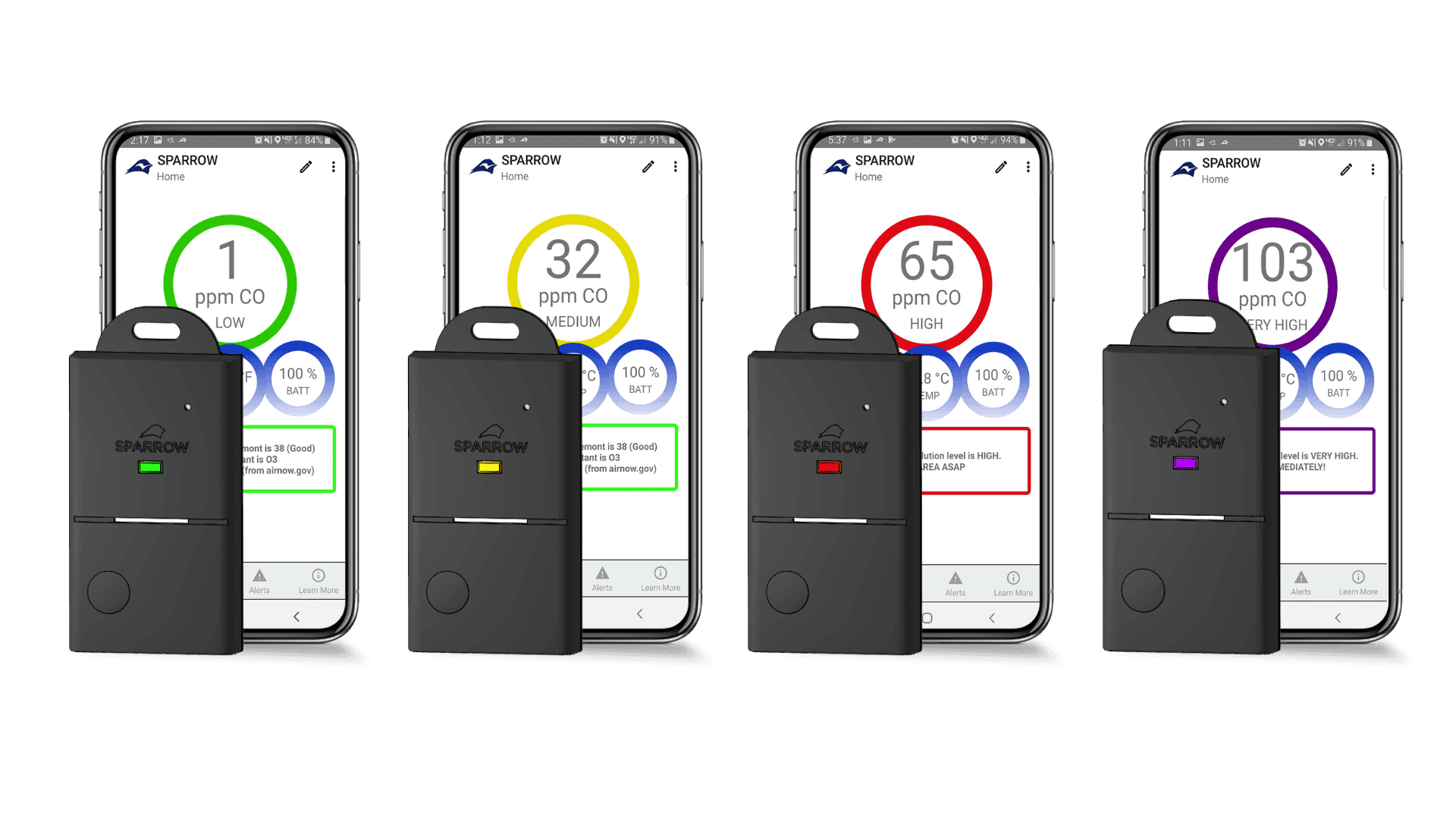
Pocket-sized CO, H2S, and ozone detectors for firefighters, first responders, HVAC technicians, and anyone working in hazardous gas environments.
Explore
Fixed and inline multi-gas monitoring systems for biogas plants, hospitals, compressed air quality, and industrial process safety.
ExploreProduct tiers ranging from pocket-sized wearable detectors through portable, fixed, inline, sensor-element, and OEM module programs let engineers and safety professionals choose the right solution for their application.
Personal gas detectors small enough for a keychain or phone case, providing real-time exposure monitoring, dosimetry, and audible/visual alarms for worker safety and personal health.
Handheld and field-portable gas detection instruments for compressed air testing, multi-gas analysis, and on-site safety monitoring in industrial and environmental applications.
Wall-mounted and surface-mounted continuous monitoring systems for facility safety, biogas plants, compressed air quality, and indoor environmental monitoring with alarm outputs.
Instruments designed for continuous monitoring of compressed air and gas supply lines, with digital displays, alarm relays, and 4-20mA analog outputs for process integration.
Bare electrochemical sensor elements in MFS, R-Series, and T-Series form factors for OEM integration, instrument design, and research applications detecting CO, H2S, NO2, NO, and more.
Signal-conditioned sensor modules combining electrochemical sensing elements with ultra-low-power analog front ends, producing calibrated voltage outputs for seamless OEM integration.
Research and development is core to Interlink Electronics. Teams support product lifecycles from concept through mass manufacturing, with custom paths for traditional and emerging gas detection applications.
Interlink's multidisciplinary team enables specialized gas-sensing products with practical deployment constraints in mind, including calibration, manufacturability, and long-term field stability.
Chemical engineering
Mechanical engineering
Electrochemistry
Electrical engineering
Sensor design
Nanotechnology
Metrology
Embedded programming
Representative products spanning wearable detectors, portable leak surveyors, inline monitors, nanotechnology sensors, and OEM gas-sensing modules.
The world's smallest CO detector and dosimeter — key-fob sized with audible alarm and exposure tracking.
View productSmartphone-connected wearable with real-time CO monitoring, GPS mapping, and health alerts via iOS app.
View productContinuous compressed air CO monitoring with digital display, alarm relay, and 4-20mA output.
View productUltra-compact 0.57-inch nanotechnology sensors weighing under 2 grams with sub-30-second response.
View productTechnology Position
Interlink's role here is not just sensor development. It is the platform where gas detection technology is translated into portable, fixed, inline, sensor-element, OEM module, and wearable instruments that can be specified, calibrated, and deployed in the field.
That makes the technology page more important than a company profile: the value is the way Interlink connects sensor science, electronics, firmware, calibration, and manufacturing transfer into usable products.
Technology Stack
Interlink's platform spans electrochemical sensors, nanotechnology-enabled sensing, wearable and portable instruments, OEM modules, firmware, and field calibration workflows for direct-use and integration-led systems.
Portable, fixed, inline, sensor-element, OEM module, and wearable detector architectures
Calibration, characterization, compensation, and validation workflows
OEM development paths from sensor to finished instrument
Interlink Gas Sensing Ecosystem
This gas-sensing platform is part of Interlink's connected ecosystem alongside SPEC Sensors, Eco Sensors, and Sparrow Sensors. Together these divisions cover the full stack — from raw electrochemical sensor elements and signal-conditioned modules through complete instruments, ozone monitoring platforms, and consumer-grade connected wearables.